
How.

In a wide red bowl, on a shelf of crayons and paper and trucks and blocks, the bulbs have grown all month. Sitting in the direct southerly light, as they do, they bask in a warmth rare this cold January in Maine. The green shoots spread up, up, and up and then, finally, the bulbs form, one, then another, then half a dozen.
I can smell the paperwhites before I see them. In the still dark of the early morning hours, as I creep downstairs, the scent catches me. It whispers of my childhood and visits to my Granny, who always had paperwhites growing during the winter months. More than once, as I pause to bend close and breathe deeply, I have thought: I would like to sit here all day and stare and stare at these flowers. Behind them, the snow has piled on the deck outside, glistening, also a gift, and the juxtaposition is startling and something to consider.
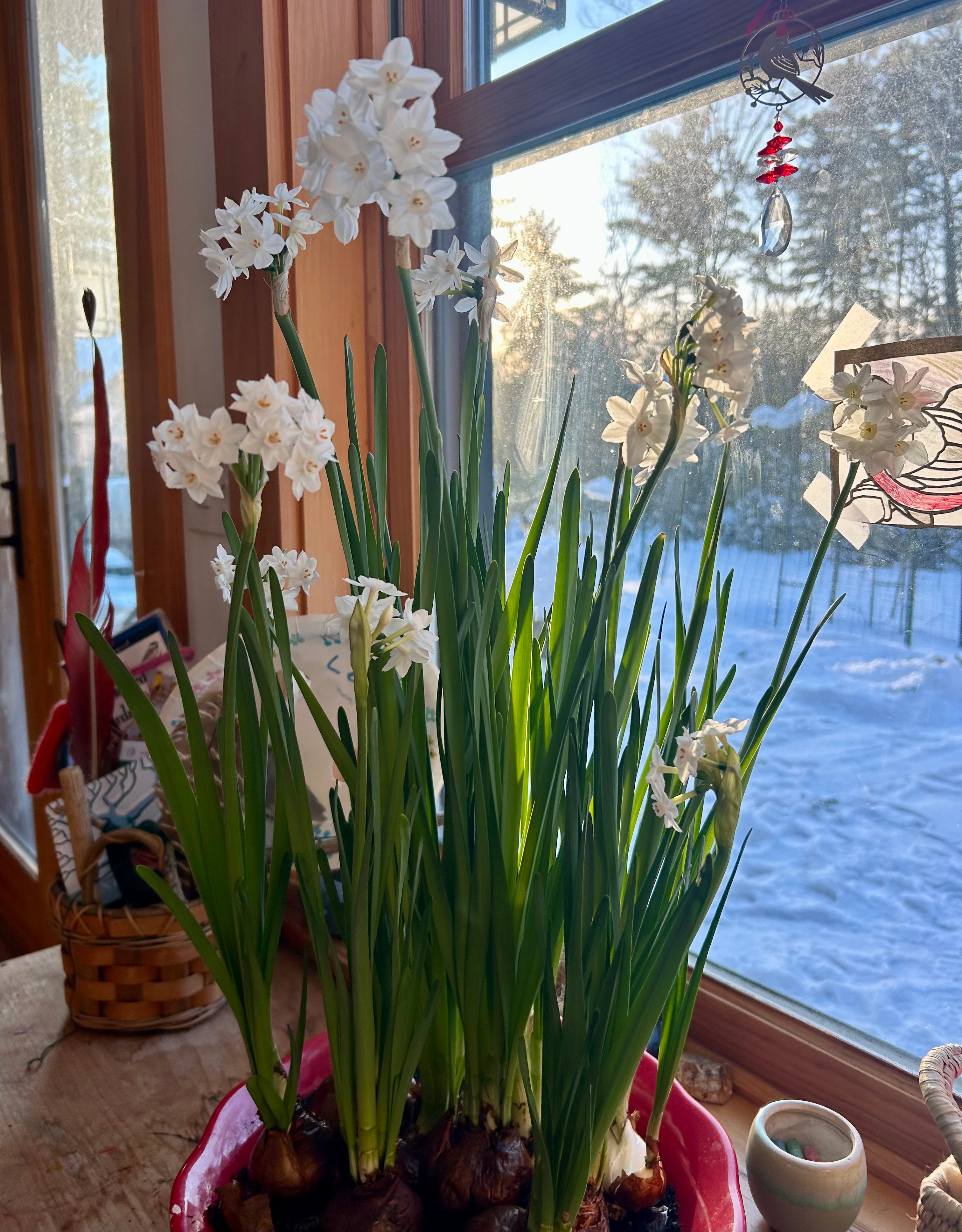
I did not sit often this month. The days were full…and nearly impossible to describe. The intersection of children growing and stretching towards the world, work growing and stretching and shifting and shaking up, and the country, this country: the violence and fear and courage and, still, something beautiful and powerful rising up and up, like the flowers towards the sun.
Two days ago, my daughter left for a two night trip with her school, her first nights away from family. Over the course of the past week, she considered the prospect of the time away with a deep thoughtfulness and a wisdom that startled me.
The morning of her departure, she sat in her bed writing notes: one for her little brother, one for her father and myself. I found our note where she left it, on the counter in the bathroom. In it, she poured out her fears about the days ahead. She wrote down each worry and left them, together, on that little piece of torn paper for her parents to hold while she was away. She did not try to take care of us by assuring us that she was okay. Instead, over and over, she wrote: “How can I do this.” She told us: “And yeah, how can I do this isn’t always a question.” And signed her note: “I love you soooo much.”
On the second night of her time away, her little brother and I had a “sleepover”. He faced the days - his first without his sister - with his own set of fears. We fell asleep that night holding hands. He is six. His hands are still soft and dimpled.
As I felt his body relax into sleep, I thought of the fear rippling all around - and within - us right now. I thought about the five year-old boy detained, his own hands still soft. I thought of the grown men, full of rage, empowered by rage, cut off from shared humanity, committing atrocities that cannot ever land in the body in anything like peace.
I thought of my own fear and of the sense of what I thought I knew crumbling and I thought of my daughter’s words: “How can I do this.”
Not a question. A statement. She knew she had to do the thing she feared even though she would not yet know how. Through doing, she would live her way into the how. She wouldn’t be alone: her dear classmates and teachers would be with her, many of them nervous as well. Together, they would find the how.
My first job after college was in New York City. As I prepared to leave my family’s home, a safe haven at the end of a bumpy dirt road, I stopped to visit my Granny, the same Granny who grew paperwhites. I told her I was nervous. She looked at me with one of her fierce gazes, her slim body straight and full of vigor. “Oh dearie,” she said. “Every important thing I have ever done in my life has scared me. Good for you.”
Soon, I will rise from my desk and head to pick up my children. I will get to hug my daughter for the first time in several days, gathering her in my arms. I will get to welcome them home to the warm house, feed them, be together, share love. Perhaps I will sit and look at the paperwhites for a few moments.
And I will continue to walk forward into the coming days, weeks, and months to find my how: the collective how, the only how that is possible. The fear is swirling, but the courage and love run deeper. Each time I turn towards fear, I will remember that, and my Granny’s words: “Good for you.” Good for us.
I love that your children are understanding fear, and how it's just part of life, and they are also learning that we can find ways to deal with it. That's beautiful! Sending love to you all.
This is so moving and sweet and personal, Johannah. I love the vulnerability and openness of your voice. So important to share in this time when we are all so frightened and yet may not have had the capacity or opportunity to put those fears into words and make connections with another around these feelings.